Move with us:
Share


geft

By Carlos Banda

Mon Nov 06 2023

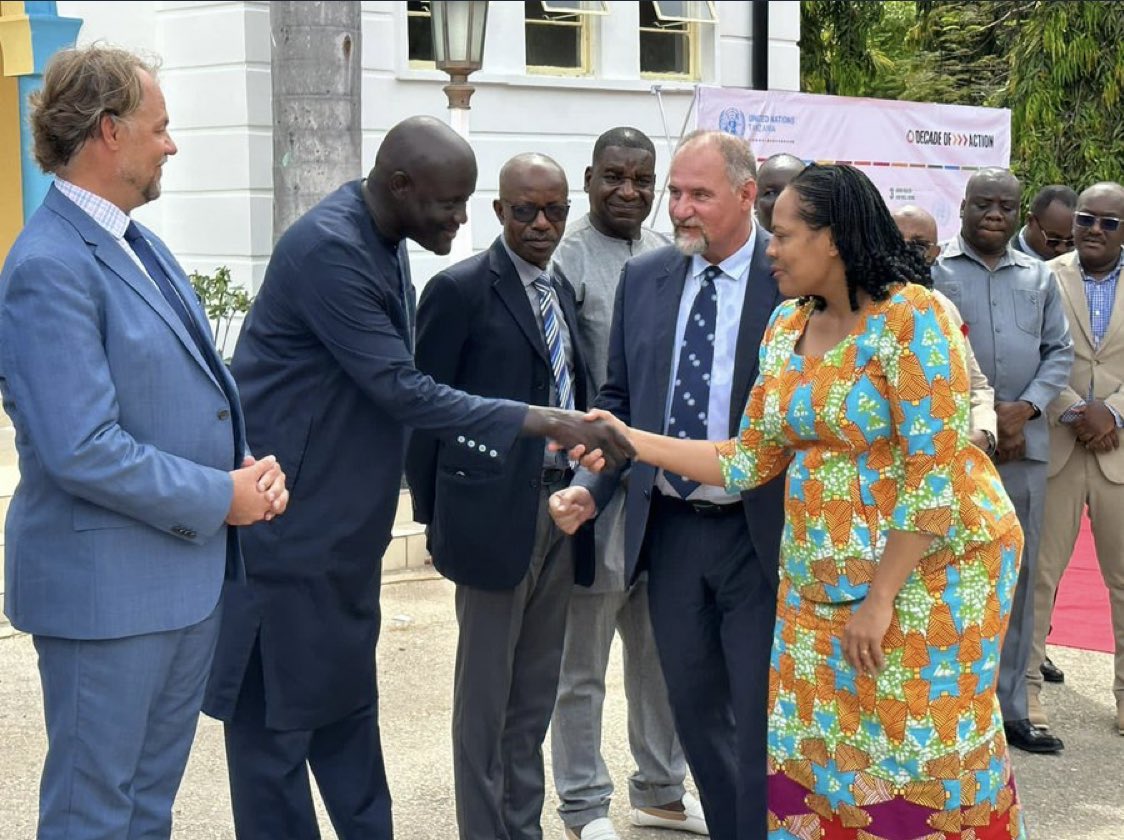
Chairperson of Tanzania National Advisory & Coordinating Committee of Generation Equality Tanzania and Minister for Natural Resources and Tourism, Hon. Angellah Kairuki shakes hands with some Heads of UN agencies in Tanzania as she arrived at Karimjee Grounds to attend the commemoration of 78 years of the United Nations.

This year's theme is “Investing in Tomorrow Today; Leveraging Tanzania's Young Population” - which emphasizes the urgency of youth investment for the acceleration of the Sustainable Development Goals (SDG).

Recommended blogs

View All

Carlos Banda3/8/2024

National gender policy set for launch tomorrow

# THE government is set to launch the National Gender and Development Policy in a bid to strengthen the country’s human capital through women empowerment. Dr Dorothy Gwajima, Minister for Community Development, Gender, Women, Elderly and Special Groups said this in Dar es Salaam yesterday at the 6th Annual Leadership Conference 2024, themed ‘Invest in women: Accelerate progress’, adding that the launch takes place tomorrow in Dodoma Region as part of International Women’s Day celebrations. “The government has implemented this agenda through various projects, including financial inclusion. In this area, the government has invested in communication infrastructure and energy, especially rural electrification so as to inspire the use of digital technology which is a vital pillar in financial services delivery,” she said. Dr Gwajima also said the government has rolled out formalization of micro financial services to ensure women are empowered economically and decrease gender-based violence in the country. She said that the government has executed various programmes to empower women so as to increase more economic opportunities, building their capacity to do business, availability of capital, markets and loans. “As you all know, President Samia Suluhu Hassan is the champion of Generation Equality Forum in the world. As a nation, we have created generation equality programme which is being implemented by the government in collaboration with the private sector so as to inspire change in the status of women by 2026,” she said. “I call upon the Association of Tanzania Employers (ATE) to continue with the provision of leadership training to women and to champion gender equality at workplace.” Patrobas Katambi, Deputy Minister in the Prime Minister’s Office (Labour, Youth, Employment and Persons with Disabilities), said that in order to have good policies, it is essential for the government to review the present laws and amend those that hinder women’s progress. “We expect to review all laws through every ministry to ensure women’s position is prioritized. The review will involve the removal of bad laws that prohibit women’s access to opportunities,” he said. Katambi said that through the ministry, opportunities for women have been created where he referred to President Samia’s intention to see more women in leadership positions in all pillars of the government namely the executive, parliament and the judiciary. Susan Ndomba-Doran, Chief Executive Officer of ATE said that gender equality is not only a good thing but it is the right thing, adding that various studies have shown that companies and businesses that observe gender equality make more profits than those that do not. “According to an article by the International Labor Organisation (ILO) entitled ‘Women on Boards: Building the female talent pipeline’, there is a strong link between women on boards and better financial performance. Inclusive and gender balanced boards can bring diverse perspectives to the table, understand customer preferences better, ensure greater due diligence, and as a result make better decisions,” she said.

Carlos Banda12/19/2023

BoT unveils financial education curriculum

FINANCIAL knowledge needs to be pushed to the common people if inclusiveness and service delivery sustainability are to be realized in the financial sector value chain, a top official has declared. Emmanuel Tutuba, governor of the Bank of Tanzania (BoT) made this observation in Dar es Salaam yesterday at the launch of the curriculum for certified financial educators, grooming finance experts from financial institutions to share the knowledge with financial service consumers at the low end. “The new curriculum targets at addressing the challenges arising from inefficient financial literacy countrywide, as financial literacy educators will be put to competency modules to spread the knowledge to people,” he said. The modules cover financial numeracy skills, financial ecosystem, money management, financial obligation and personal financial protection, he stated. The targeted groups are financial regulators, corporate financial outreach officials, government entities, parastatal institutions and non-governmental organizations involved in delivering financial education, he said. Urging for inclusive implementation of the curriculum, he said it was prepared in an inclusive manner, thus its implementation phase has to be inclusive as well, he said. The government hopes to see all groups of the society benefiting from the knowledge embedded in the curriculum, he said, challenging higher learning institutions to effectively engage stakeholders. “Sustainable initiatives that can withstand challenges during implantation are the ones that reap benefits to the public,” he said, underlining expectations that financial literacy will be long lasting. People in the informal sector need to be reached out and empowered with this knowledge, he specified. Beng’i Issa, the National Economic Empowerment Council (NEEC) executive secretary, commended the initiative towards boosting financial literacy countrywide. It will help women often exposed to challenges in doing business as most of them have inadequate financial knowledge, she said, affirming it is a pillar in pursuing the public economic empowerment policy. Finance and investment are crucial pillars in individual and national economic development, she said, citing key objectives in empowering people as access to finance and having control over their income like having a savings account. Without savings no plans are possible, this a savings account is a milestone, she said, asserting that spreading the curriculum will help address challenges facing budding entrepreneurs all over the country. She said many women meet with challenges, delve into entrepreneurship where they make up 54 percent of micro-economic units and small businesses as a whole. “Many of them wish to expand their capital but they fail to do so because they do not have the right financial understanding,” she said, pointing out that one might see women accessing loans from microfinance institutions “but they fail to understand what it means to have a loan.” Someone may take a loan and will be required to pay it back with an interest of three percent. However, due to financially illiteracy they cannot really understand the burden that comes with the loan, while the problem is also evident in the formal sector, as even educated people struggle with handling money and budgeting, she remarked. Prof Andrew Mbwambo, Iringa University deputy vice chancellor, said that if the curriculum is properly taken up, the public will have a reliable source of knowledge with clear content. Financial interaction will be more articulate, making the public adequately knowledgeable about what financial acts involve, clearly evaluating what can be properly done and in what way. /ends /jz/sm
Carlos Banda11/14/2023

Optimism high as gender funding conference kicks off in Dar

GENDER activists have expressed optimism over gender financing conference kicking off from November 15 to 17 in Dar es Salaam. They have said that the meeting provides a platform for Tanzania to showcase its efforts in championing gender equality, but also helping relevant actors to understand how President Samia Suluhu Hassan achieved generational equality in Tanzania. Mgeni Hassan Juma, an Executive member of the Generation Equality Forum (GEF) cited that far from showcasing Tanzania’s achievement in advancing women’s empowerment, the ministries of gender, women and special groups and the ministries of finance from around the world will engage to discuss on the resources needed and the steps to be taken to ensure women and youth are not left behind in development. The GEF committee and Deputy Speaker of the Parliament of Zanzibar said the meeting gathers different countries coming to Tanzania to talk about gender equality and issues pertaining to women, and men. She said: “This meeting is very important because for the first-time, different countries will come to Tanzania to discuss the issues of importance to women and men. We also know that President Samia Suluhu Hassan is the Global Champion for Generation Equality and she has pledged to champion gender equality.” Hence, she formed a special committee involving men and women and we have been conducting various activities to empower women. Mgeni also added that through the meeting the committee alongside other institutions will get to learn how other countries are executing efforts to achieve gender equality. Beng’i Issa, the Executive Secretary of The National Economic Empowerment Council (NEEC) said the meeting is vital for tabling issues concerning equality and implementation citing that generation equality demands commitment, resources. “The meeting is crucial because we get to discuss important issues around equality and how we can act practically on generation equality because it demands commitment and resources. Hence, this is a forum to reignite the discussion between the ministries of gender and finance and also to fasten the availability of resources for women and youth empowerment so as to achieve the goals of the gender equality program, said Beng’i Issa. Leticia Mukurasi, Gender and Development Specialist and member of the generation equality forum (GEF) emphasized on the importance of analysing the extent of awareness and responsiveness across the continent on gender issues and assessing on the use of resources allocated to achieve the objective of gender equality. “I would like to know the extent of awareness and responsiveness across Africa on these issues of ours that is the budget allocated and if yes, is it properly utilized? If you want to track it, you must know exactly what and where to look. By doing so, you will be able to know which resources have been used to cater for women and men each and why you have done so. It is important for actions to be preceded by analysis because you cannot just place resources haphazardly,” said Leticia.

Subscribe to our newsletter

While some beaches may boast soft granules

gef_logo
UN House182,
Mzinga Way, Off Msasani Road
Dar es salaam Tanzania

All right reserved GEF @ 2022

Designed and developed by iPF Softwares